JAXA's MMX is on its way to Mars to bring back the first sample from Phobos
By Next News Hub Editorial Team · Published · 2 min read
JAXA's Martian Moons eXploration spacecraft launched on H3 flight No.10 on 20 October 2026 (JST). It is due to reach Mars about a year later, study Phobos and Deimos, land on Phobos and return at least 10 grams of material to Earth in Japanese fiscal year 2031.
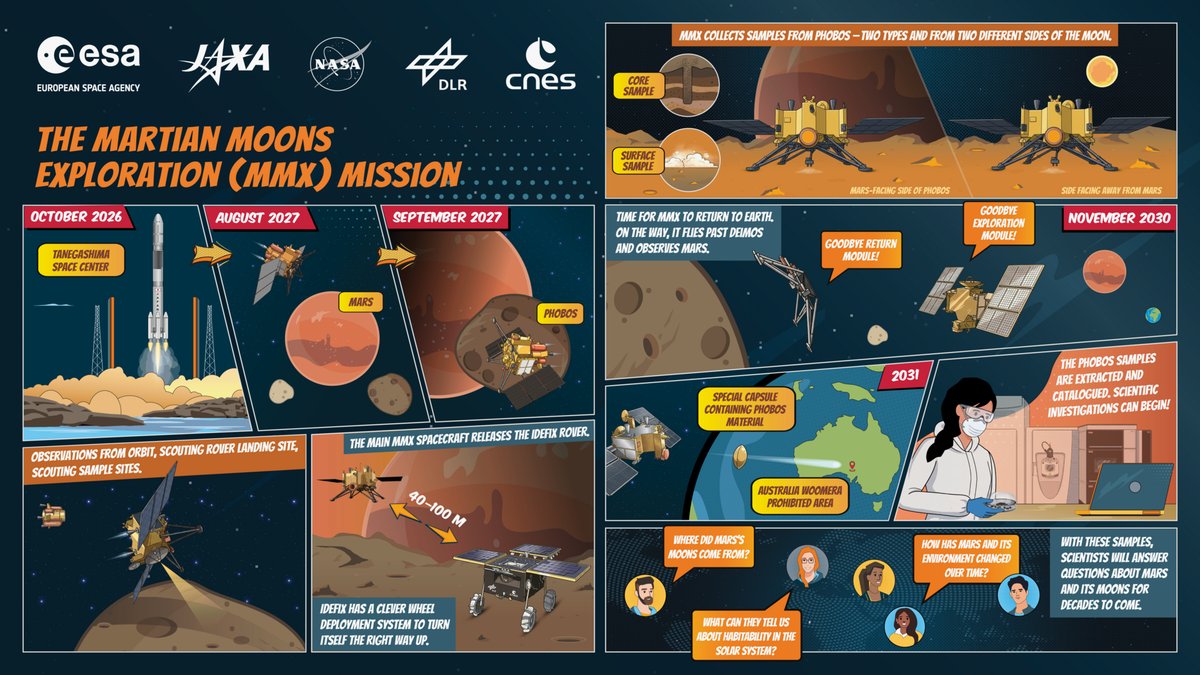
Japan has launched the first mission designed to bring material back from the Mars system. The Martian Moons eXploration (MMX) spacecraft lifted off aboard H3 Launch Vehicle flight No.10 from Tanegashima Space Center at 04:41:03 JST on 20 October 2026 (21:41 CET on 19 October), JAXA said.
What we know
About 71 minutes after liftoff, separation of the MMX spacecraft was confirmed and it was injected into its planned orbit, according to JAXA's launch report.
The mission, led by JAXA with NASA, the French space agency CNES, the German Aerospace Center DLR and ESA, will study both Martian moons, Phobos and Deimos, and land on Phobos to collect a sample. According to ESA's factsheet, the spacecraft will arrive at Mars around a year after launch and orbit Phobos for three years. It will return to Earth to deliver its sample in Japanese fiscal year 2031.
MMX has three modules (propulsion, return and exploration) and weighs about 4,200 kg with fuel. It carries two sampling systems, a corer that reaches about two centimetres deep and a pneumatic sampler, and aims to bring back at least 10 grams of Phobos material in a capsule about 60 cm across that will land in Australia. Before the main spacecraft lands, it will deploy Idefix, a 25 kg rover built by CNES and DLR that will weigh the equivalent of just 15 grams in Phobos's weak gravity.
Why it matters
Scientists still do not know where Mars's moons came from. They may be captured asteroids, or debris thrown into orbit when a large object hit the young Mars. A sample could settle the question, and if the moons formed from Martian material, it may also carry a record of early Mars.
Signals suggest
Our inference: after Hayabusa and Hayabusa2, MMX extends Japan's lead in sample-return missions, and a successful round trip would be the first spacecraft to visit the Mars system and come back. The key milestones to watch are arrival at Mars and the Idefix deployment.
Key dates
- 20 October 2026 (JST): launch on H3 F10.
- About a year later: arrival at Mars.
- Japanese fiscal year 2031: sample return to Earth.
Sources
Get the stories first
Short, sourced news from NEXT NEWS HUB. Occasional emails — unsubscribe any time.