ESA's Hera arrives at asteroid Didymos to inspect DART's impact
By Next News Hub Editorial Team · Published · 2 min read
Europe's planetary-defence probe Hera is due at the Didymos–Dimorphos asteroids on 4 November 2026, a month early. First close-up images are expected on 25 November.
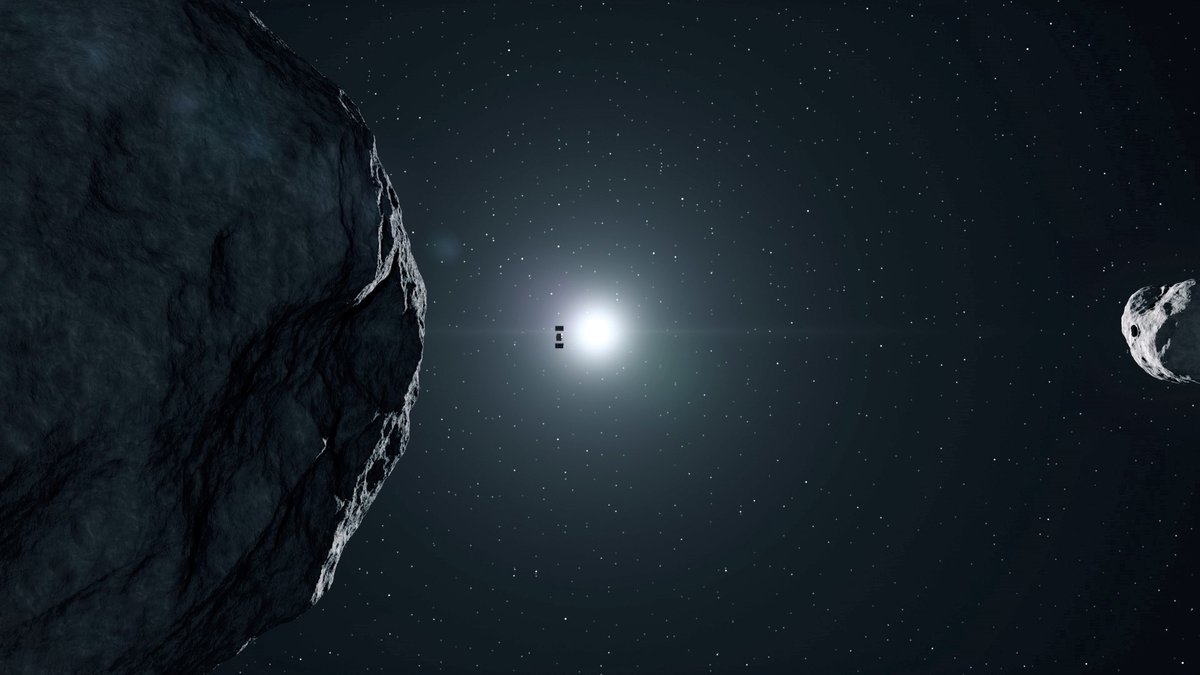
Two years after leaving Earth, the European Space Agency's Hera spacecraft is about to reach its destination. According to ESA's mission timeline, Hera arrives at the binary asteroid system Didymos–Dimorphos on 4 November 2026, with its first proximity manoeuvre scheduled for 01:00 UTC (02:00 in Rome). That is a month earlier than originally planned.
What we know
Hera's job is to study the aftermath of NASA's DART mission, which deliberately crashed into the small moon Dimorphos in September 2022. NASA describes that impact as humanity's first attempt to purposely change the motion of a celestial object: it shortened Dimorphos's orbit around Didymos by about 32 minutes. What the impact left behind, a crater or a reshaped asteroid, has so far only been inferred from telescopes on Earth.
ESA said in October 2025 that the spacecraft's good performance and a more aggressive braking plan would let it arrive in November 2026 instead of December. The braking happened in October 2026: a 93-minute burn on 15 October and a second burn on 22 October that cut Hera's speed relative to the asteroids by 70 m/s, from about 2,300 km away, followed by smaller transition manoeuvres.
There is no orbit to enter. The asteroids' gravity is far too weak, so Hera will fly a series of arcs past the pair, at 20 to 30 km from Dimorphos in the first phase. ESA's timeline, as reported on 23 October, lists a public arrival event in Berlin on 25 November, where the first pictures are expected, the release of the CubeSat Juventas on 16 January 2027 and of Milani on 30 January 2027, and the end of the nominal mission on 2 June 2027.
An Italian piece of the mission
Hera carries two suitcase-sized CubeSats. According to ESA, Milani will be flown by Tyvak in Italy, while GomSpace in Luxembourg will fly Juventas, which carries a radar to probe the inside of Dimorphos. Both small craft are planned to attempt landings at the end of their missions.
Signals suggest
Arrival is only the start. If the November images match the plan, Hera will produce the first close maps of both asteroids and the first direct look at the DART impact site within weeks. Those measurements are what turn a one-off experiment into a technique that could be repeated if an asteroid ever threatens Earth. Plans can still move if a manoeuvre slips, so the dates beyond 4 November should be read as ESA's current schedule rather than fixed events.
Why it matters
Planetary defence is one of the few space missions that concern everyone on Earth equally. Hera is the second half of the first full-scale test of deflecting an asteroid, and Europe is the one that will measure whether it worked as scientists think.
Next News Hub will update this story when ESA confirms the arrival and publishes the first images.
Sources
Get the stories first
Short, sourced news from NEXT NEWS HUB. Occasional emails — unsubscribe any time.